

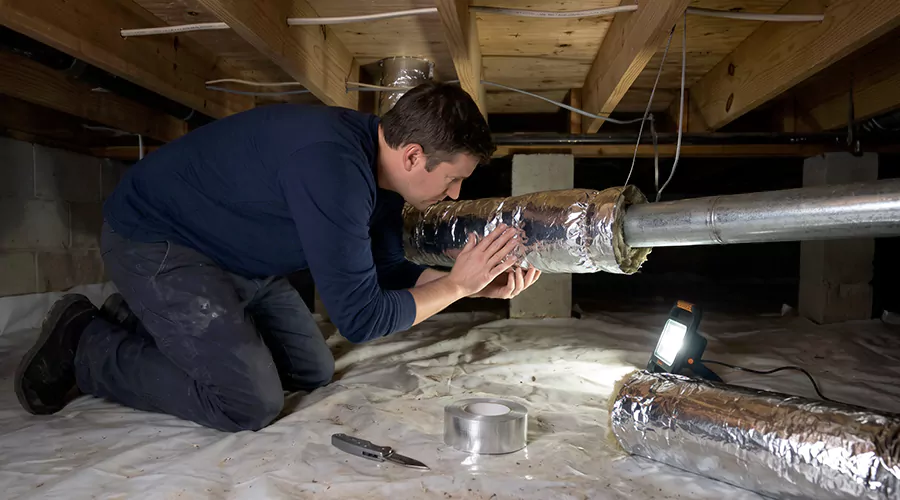
To insulate air ducts in a crawlspace, first inspect and repair damaged ductwork, seal air leaks at joints and connections, then install appropriately rated duct insulation with its vapor-resistant facing toward the outside. The insulation should cover the duct continuously without gaps, compression, or exposed seams that allow humid crawlspace air to contact cold duct surfaces.
Crawlspaces frequently contain heating and cooling ducts that distribute conditioned air throughout the home. When these ducts pass through an unconditioned space, they can lose heat during winter and gain unwanted heat during summer. Professional commercial air duct cleaning can help remove accumulated dust and debris from commercial HVAC ductwork when an inspection shows that cleaning is needed.
In humid weather, cold supply ducts may also develop condensation if surrounding moisture reaches their surfaces. This can damage insulation and nearby building materials. Proper insulation helps limit heat transfer and reduce condensation risks. However, insulating damaged or leaking ducts without first correcting those problems can conceal defects and allow them to continue. Understanding duct insulation materials, installation techniques, and crawlspace moisture conditions helps homeowners plan the project correctly.
Why Should You Insulate Air Ducts in a Crawlspace?
Duct insulation reduces unwanted temperature changes as conditioned air travels through the distribution system. During summer, cooled air moving through an exposed metal duct may gain heat from the crawlspace. During winter, warm air can lose heat to colder surroundings. The U.S. Department of Energy recommends sealing and insulating ducts located in unconditioned spaces, including vented crawlspaces.
Proper insulation with suitable vapor protection also reduces the likelihood of condensation forming on cold metal ducts. However, insulation does not repair air leaks. Those openings must be sealed separately.
What R-Value Should Crawlspace Duct Insulation Have?
R-value measures resistance to heat flow. Higher values indicate greater thermal resistance. DOE Building America recommendations for duct improvements commonly use at least R-8 insulation on supply ducts and R-6 on return ducts in unconditioned spaces.
| Duct Location or Condition | Common Insulation Recommendation |
|---|---|
| Supply ducts in an unconditioned crawlspace | R-8 or higher |
| Return ducts in an unconditioned crawlspace | R-6 or higher |
| Ducts within a properly conditioned crawlspace | Evaluate local code and system requirements |
| Existing insulated flexible ducts | Verify installed R-value and condition |
| Duct boots in unconditioned spaces | Seal and insulate appropriately |
These values are useful planning targets, not substitutes for current locally adopted energy-code requirements.
Some jurisdictions or efficiency programs require different insulation levels.
What Type of Insulation Is Best for Crawlspace Ducts?
Foil-faced fiberglass duct wrap is commonly used around rigid metal HVAC ducts. The material provides thermal resistance, while its exterior facing acts as a vapor retarder when the seams are properly sealed. Pre-insulated flexible ducts are another common option. They usually contain an inner air liner, fiberglass insulation, and an exterior protective jacket.
| Insulation Type | Typical Application |
|---|---|
| Foil-faced fiberglass duct wrap | Existing rigid metal ducts |
| Factory-insulated flexible duct | Flexible supply and return branches |
| Approved rigid insulation systems | Certain specialized duct installations |
| Listed duct insulation products | Installations requiring particular fire or thermal ratings |
Choose insulation specifically intended for HVAC duct applications.
Ordinary loose household insulation should not simply be piled around ducts as a substitute for a correctly installed duct wrap system.
What Tools and Materials Do You Need?
Before starting, gather suitable materials and safety equipment.
Common items include:
- HVAC duct wrap with the required R-value.
- UL 181-compatible duct sealing materials.
- HVAC mastic for accessible duct joints.
- Fiberglass mesh tape for suitable larger seams.
- Measuring tape.
- Insulation cutting tools.
- Appropriate mechanical supports.
- Manufacturer-approved facing tape.
- Protective gloves and eye protection.
- Suitable respiratory protection.
- Work lighting rated for the environment.
Crawlspaces may contain electrical hazards, moisture, pests, sharp objects, and contaminated materials.
Do not enter a flooded or otherwise unsafe crawlspace. Suspected asbestos-containing duct insulation should be evaluated by qualified professionals before disturbance.
How to Insulate Air Ducts in a Crawlspace Step by Step?
Step 1. Inspect the Crawlspace
Determine whether the crawlspace is vented, unconditioned, or properly sealed and conditioned. Look for standing water, damp soil, plumbing leaks, damaged insulation, and pest activity. A moisture problem should be corrected before new duct insulation is installed.
Step 2. Examine the Existing Ductwork
Inspect accessible metal ducts, flexible branches, connections, and supports. Look for crushed sections, holes, disconnected joints, and wet or deteriorated insulation. Damaged components may require replacement before the insulation work begins.
Step 3. Check for Existing Insulation
Some flexible ducts already contain factory-installed insulation. Inspect the outer jacket for tears, gaps, and compression. Adding a second layer without addressing the underlying damage may not provide a reliable solution. A contractor can determine whether repair or replacement is appropriate.
Step 4. Seal Air Leaks
Clean and dry accessible metal duct joints before applying approved sealant. The Department of Energy recommends HVAC mastic or appropriate UL 181-rated tape for suitable duct connections. Disconnected joints should be mechanically repaired before being sealed. Ordinary cloth-backed duct tape is not recommended because it can deteriorate and lose adhesion.
Step 5. Seal Duct Boots and Connections
Inspect the areas where duct branches connect to floor registers and main trunks. Gaps can allow conditioned air to escape into the crawlspace. DOE Building America recommends sealing accessible duct boots to finished surfaces using suitable materials. Flexible duct connections require specific procedures for securing and sealing the inner liner before restoring the insulation jacket.
Step 6. Measure the Duct Dimensions
Measure the circumference or perimeter of each rigid duct section. Select the insulation dimensions according to the manufacturer's installation chart. Duct wrap often requires extra material to maintain its rated thickness after wrapping. Do not simply cut insulation to exactly the duct circumference without checking the product instructions.
Step 7. Cut the Insulation
Prepare sections of foil-faced duct wrap suitable for the duct dimensions. DOE guidance describes allowing overlap at the wrap seams. Keep the insulation clean and dry during installation. Avoid damaging the vapor-resistant facing while cutting.
Step 8. Wrap the Duct
Position the insulation around the metal duct with the foil or other approved facing outward. The insulation should remain in contact with the duct without being compressed excessively. Compression can reduce the installed thermal resistance. Cover straight sections, elbows, and other appropriate surfaces continuously.
Step 9. Secure and Seal the Facing
Overlap the vapor-resistant facing according to the insulation manufacturer's instructions. Use compatible tape, staples, or other approved fastening methods. Seal seams and joints to prevent humid crawlspace air from reaching cold duct surfaces. Gaps in the vapor-resistant jacket can contribute to condensation even when the insulation material itself has an adequate R-value.
Step 10. Insulate Elbows and Connections
Duct elbows, branches, and fittings often require additional cutting and careful wrapping. Maintain continuous insulation around these irregular shapes.
Avoid leaving exposed metal at collars and connections. Do not cover equipment access panels, labels, controls, or components that must remain accessible.
Step 11. Check the Duct Supports
Inspect hangers and supports to confirm that the added insulation is not compressed or damaged. The duct should remain properly supported without sagging.
Avoid securing supports so tightly that they flatten flexible branches or compress duct wrap. Any significant structural support problems should be corrected by a qualified contractor.
Step 12. Verify the Completed Work
Inspect the finished installation for exposed metal, loose seams, damaged vapor facing, and compressed insulation. Check that duct connections remain secure.
After the HVAC system is restored to normal operation, observe whether condensation returns under representative conditions. A professional can also check system airflow and duct leakage when significant repairs have been performed.
Should You Seal Air Ducts Before Insulating Them?
Yes. Duct sealing should generally be completed before insulation is installed. The Department of Energy explains that insulating a leaking duct does not stop air from escaping. Sealing first also keeps joints visible while the contractor repairs them.
Once the duct is sound and the sealing materials have been applied according to their instructions, insulation can be installed over the suitable surfaces. A professional air duct sanitization service can also treat accessible duct surfaces when an inspection identifies a need for sanitization.
This sequence reduces the risk of covering defects that would otherwise remain uncorrected.
How Does Crawlspace Humidity Affect Duct Insulation?
Moisture control is an important part of crawlspace duct performance. Humid air can condense on cold ducts, especially when insulation is missing or the vapor-resistant facing contains gaps. Ground moisture, plumbing leaks, and exterior drainage problems can increase crawlspace humidity. DOE Building America describes sealed and insulated crawlspaces as one possible approach for reducing moisture and improving conditions around HVAC equipment.
However, crawlspace encapsulation requires separate planning for drainage, soil vapor barriers, radon, pests, and combustion safety. Wrapping ducts alone does not correct a damp crawlspace.
Can You Use Spray Foam on Crawlspace Air Ducts?
Certain professional insulation systems may use spray-applied materials where approved. However, spray foam is not automatically appropriate for every HVAC duct or surrounding construction. Application methods, fire-safety requirements, product compatibility, and future access must be considered. A contractor should confirm that the selected system is approved for the intended installation. Do not spray unapproved foam onto furnace components, flues, electrical equipment, or concealed areas without an appropriate assessment.
How Much Does Crawlspace Duct Insulation Cost?
The cost depends on duct length, insulation R-value, crawlspace accessibility, and the condition of the existing system. A straightforward project involving exposed, undamaged ducts may cost less than work requiring damaged insulation removal, duct repairs, or moisture remediation. Labor can increase when the crawlspace has limited clearance or difficult access.
Request estimates separating duct sealing, insulation materials, installation labor, and any crawlspace moisture work. A contractor should also explain whether duct leakage or airflow testing is included.
Can You Insulate Crawlspace Ducts Yourself?
A homeowner with suitable experience may be able to wrap accessible, sound metal ducts. However, crawlspaces can present electrical hazards, poor access, moisture contamination, and potential pest-related health risks.
Professional assistance is recommended when ducts are damaged, insulation is wet, or suspected asbestos-containing materials are present. If combustion appliances are located nearby, duct changes should not interfere with required clearances or combustion safety.
Conclusion
Insulating air ducts in a crawlspace can reduce unwanted heat transfer and help prevent condensation when suitable insulation and vapor protection are installed. Begin by inspecting the crawlspace, correcting moisture problems, repairing duct damage, and sealing air leaks. Foil-faced duct wrap is commonly used on rigid metal ducts, with R-8 supply and R-6 return insulation serving as useful DOE planning targets for unconditioned spaces. A properly completed installation should provide continuous insulation without gaps or compression.